

Wild Horses
DNA STUDY ON BC-BRITTANY TRIANGLE WILD HORSES CHALLENGES HISTORY
A soon to be released study of the genetics of wild horses in a remote corner of the province poses more questions than it answers. The study by world horse DNA expert Dr. Cothran and biologist Wayne McCrory was done at the Texas A & M University for VWS, FONV (Friends of Nemaiah Valley) and the Xeni First Nations Government. It is the first of its kind in western Canada. The Brittany Triangle is the remotest area left in western Canada where some 200 wild horses have roamed since before the coming of Europeans. The DNA study area is part of the Eagle Lake Henry ?Qayus wild horse reserve created by the Xeni Gwet’in First Nations – the only wild horse preserve in western Canada. DNA was analyzed from blood samples taken from domestic horses captured in the wild as well as from hair samples collected from tree branches and bedding areas. Historic documentation indicates that Brittany horses most likely originated from horses of Spanish ancestry brought in to the area by Tsilhqot’in First Nations about 1740 along ancient trade routes from Plateau grasslands to the south. However, the DNA study found very little remaining Spanish ancestry. The origins were more from the Canadian Heritage Horse breed or its ancestors. The most intriguing result of the genetic study is the possibility that Yakut horses, an ancient horse of Russian heritage, also contributed to the origins of the herd. How these bloodlines got to the remote Chilcotin is a mystery since the Russians only ever brought a small number of horses across to their Pacific coast fur trading posts. The report will be released in several months. (Valhalla Wilderness Society)
Map prepared by Alan Dobb Consulting:
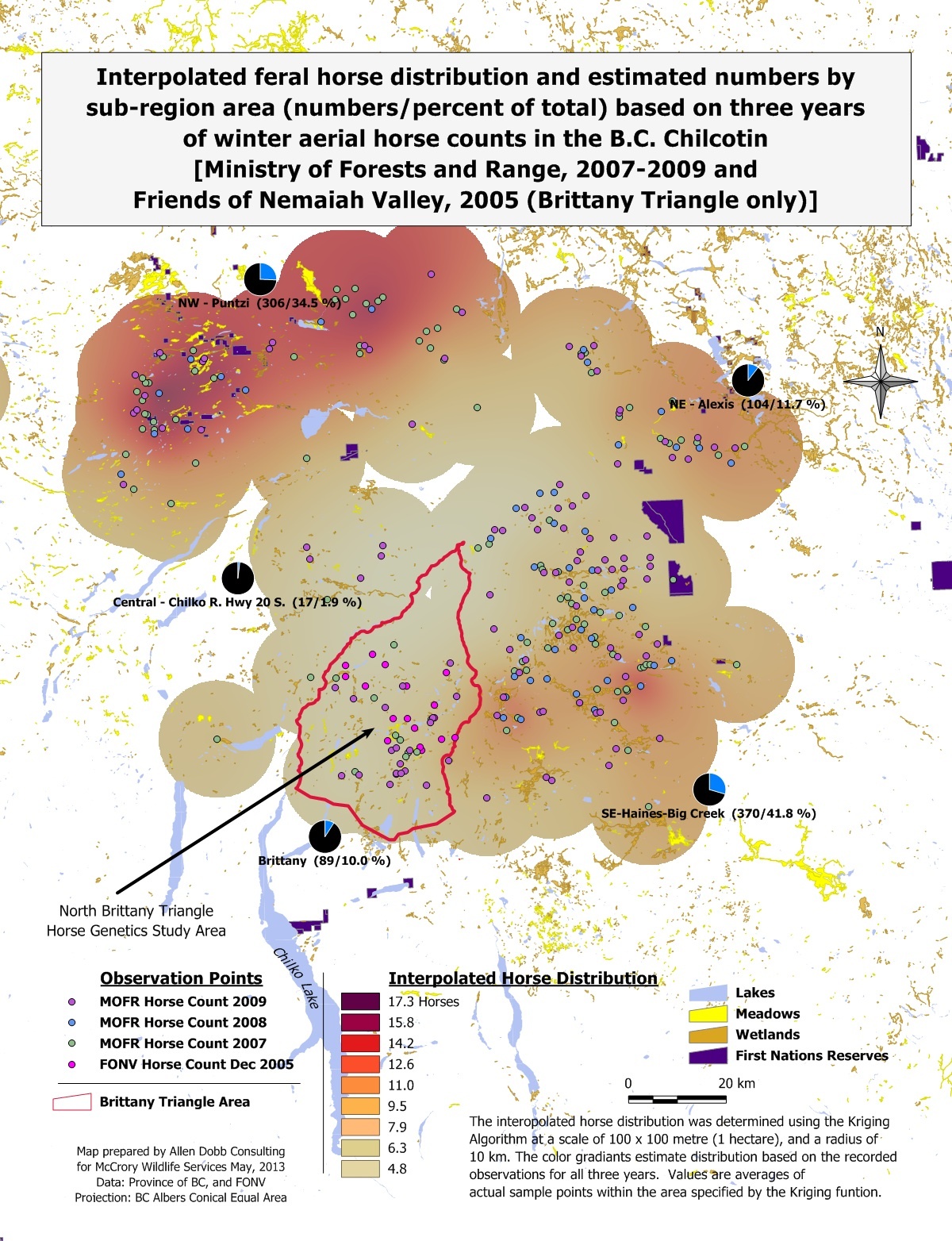
There are estimated to be between 800 and 1,000 wild or free-roaming horses in the Chilcotin. As many as 42% of these can be found within the ?Elegesi Qayus Wild Horse Preserve declared by the Xeni Gwet'in First Nations Government in 2002. The core Brittany Triangle area, lying between the Chilko and Taseko Rivers, contains about 200 truly wild, genetically distinct horses. The latter have experienced dramatic environmental and fire related environmental changes over the past ten years, yet continue to thrive and maintain their numbers, thus demonstrating considerable biological resiliency.
The Brittany and Nemiah Valley horses have achieved iconic status and have become the focus of intense global interest because of speculation as to their genetic and historic origins. They are the subjects of ongoing genetic analysis and cultural and ecological research by FONV, independent researchers, and graduate students. That research will be found on this web-site as it becomes available.
Since the wild horse preserve declaration, they have been protected by a Xeni Gwet'in Wild Horse Ranger funded by FONV. In 2007 the Supreme Court of B.C. found that the Tsilhqot'in people had an aboriginal right to manage them for their own use.
The province of British Columbia still refuses to recognize them as a species with a right to remain on the land, even though historical evidence is clear that they long preceded European settlement. FONV will continue to argue for their recognition as legitimate wildlife.