Chilcotin Wild Horse Sanctuary

In the United States wild horses have been officially protected since 1971 on both BLM land and on several large private preserves. By contrast there is virtually no protection for wild horses in Canada. The only exceptions are those on Sable Island off Nova Scotia and some Newfoundland ponies. Consequently, there are approximately 40,000 protected mustangs in the U.S. today, while in Canada wild horses in the west probably number only in the hundreds. Historically they have been frequently shot or rounded up for slaughter, and indeed there was a bounty on them until recent years. Ranchers regularly shot them as nuisance animals.

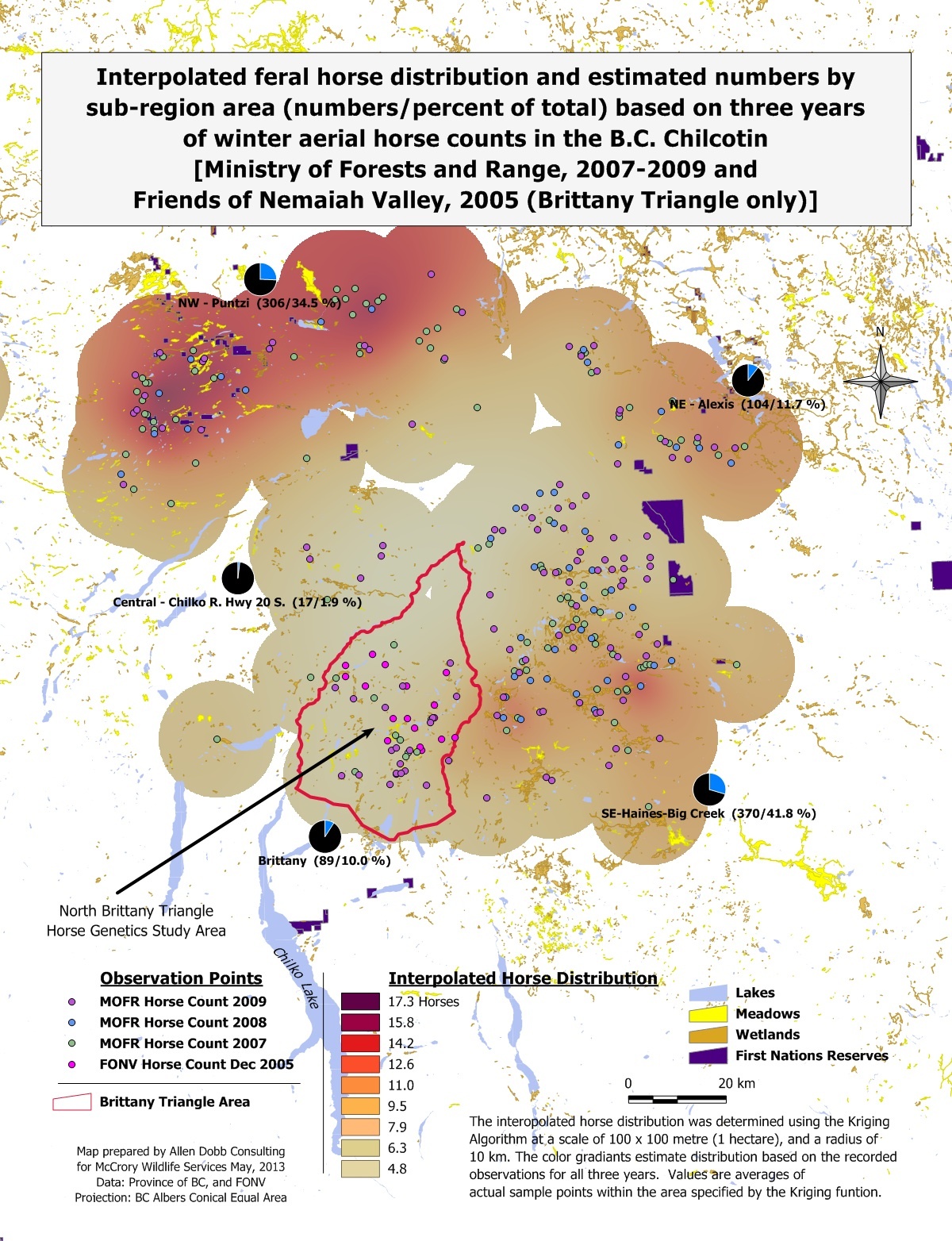
In British Columbia the Chilcotin holds the last major numbers of wild horses. Communication from a recent range manager for the Ministry of Forests in Alexis Creek, King Campbell, indicates that there are about 400, including 75 in the Brittany triangle. The M.O.F. say they conduct a fly over every February to determine these numbers. Personal experience (David Williams) and conversations with local guide outfitters and Xeni Gwet’in First Nation members indicate that there are probably closer to 100 in the B.T. and possibly twice that number. All indications are that their numbers are very slowly increasing or are stable at present. Milder winters over the past few years may have contributed to a slight recent increase in some areas. Nevertheless, this appears to be an intact ecosystem in a state of balance without undue competition between species which share habitat requirements.

History: A recent review of archival sources has revealed that horses arrived some years before Europeans in the area. For example, Simon Fraser while travelling down the Fraser River and reaching the mouth of the Chilcotin River in 1808 reported that “The natives make use of horses.” He also notes,

“Those who came to see us from below (Soda Creek) were on horseback , But tho’ animals are plenty and the country in many places clear of wood, they do not use them to hunt, but use them to carry themselves and baggage, which is the chief cause of them not going much in canoes.”

Since these horses arrived before European contact in the region, their origin was most likely from the Spanish stock which provided mounts for the plains Indians over 400 years ago. This was the most likely source of horses at that time. It is documented that some of the Spanish horses had filtered up into the Kootenay District well over 200 years ago. Given there have been wild horses in the Chilcotin District for 200 years, we have no reason to think they have not been in the Brittany Triangle just as long. Genetic dilution has occurred with the arrival of ranching in the latter part of the nineteenth century, when domestic stock began to augment existing wild bands.

The Brittany Triangle: The B.T. itself is approximately 155,000 hectares, a visually stunning ecosystem comprising high elevation lodgepole pine forest extensively dotted with small lakes, streams and associated riparian areas with spruce and aspen groves. It is rich in wildlife including grizzly and black bears, cougar, wolves, wolverine, coyotes, fisher and marten. Ungulates like moose and mule deer abound. Extensive wetland areas, increased in size by beaver activity, provide rich habitat for an incredible array of bird life. And of course there are the horses! The Triangle is bounded on the west by the Chilko River, on the East by the Taseko, and to the south by Nemaiah Valley and the South Chilcotin Mountains. Until recently this area has been protected by its isolation (the first truck road reached the valley in 1973), an isolation which has allowed the 380 strong Xeni Gwet’in First Nation to retain its way of life and its culture. Many of the elders still speak only their own Chilcotin language, and it is taught by immersion in the local school.

The Xeni Gwet’in still practice a horse culture and closely identify themselves with their horses. They conduct periodic roundups of the wild horses of the Brittany and train them for their own use. These horses represent both an economic and spiritual resource to the people. A main feature of their annual rodeo is a mountain race down which daredevil riders race at breakneck speed on horses specially trained to accomplish this difficult task.

Personal observation: Extensive walking transects and numerous recreational forays on foot throughout much of the Brittany Triangle reveal a landscape riddled with wild horse trails. Droppings are everywhere and the numerous wild meadows are obviously well used for grazing. Stallion piles are much in evidence. Horses are the dominant species here in a landscape well nigh perfect for their use. Their numbers appear to be kept in check by predation (wolves and cougar with probably some bear) and the harsh winters of the area. Some have expressed concern that if too numerous they could adversely impact moose, but some research indicates that wild horses and moose do not compete directly for food sources. It is interesting to note, too, that moose have only been in this area since the 1920’s, up to one hundred and fifty years after the arrival of the horse. Another concern we have heard expressed is that they could impact cattle grazing lands, however most of the Brittany Triangle is wilderness with relatively little land being used for cattle grazing. Certainly every attempt should be made to accommodate existing cattle grazing rights and all such concerns should be addressed by further research and recommendations made.

Numerous bands can be found in any of the many different meadows which dot the landscape. These are connected to one another by an extensive wild trail system. Each band is led by a stallion. The bands number from three or four to as many as eighteen or twenty at a sighting. The last three years (2000 to 2002) we have seen three or four foals to a band as well as two or three yearlings. Numbers do appear to be stable at this time. The ground doesn’t seem to be over used, though in late fall the waterholes are well trampled. These horses are very wild and it takes skill to get at all close to them. The stallions are extremely alert and round up the band at the slightest alarm and take them off into the trees. It could be dangerous to approach them on foot should this even be possible. The quality of many of these horses appears to be very high and local acquaintances who own horses captured in the Brittany are proud of the quality and the toughness of the stock. This is in accord with observations made by scientists and others familiar with wild horses (mustangs) in the western United States. These relatively small, tough animals demonstrate several of the characteristics of the Spanish horse type. Some of the stallions show superior conformation, intelligence and condition to many ranch and domestic saddle horses.

Wild versus Feral: While one M.O.F. range officer expressed the opinion that most of these horses would have brands on them and hence are escapees from ranches, our personal observations and video recordings show no evidence of this. It stands to reason that as they have been here longer than anyone presently living can remember, they will in the majority have been born in the wild. Certainly their behaviour is that of wild animals. We believe that the distinction of wild vs. feral is mainly a political one. It is more difficult to make the case for protection of domestic animals gone wild and that is the way the government and other interest groups seem to want it. At the same time, government people, and even ranchers, when asked about it feel that something wonderful would be lost should these horses disappear, especially as a result of either deliberate government policy or simply neglect to take care in the face of massive industrial exploitation of a hitherto safe environment.

The Threat: The Nemiah Valley, for forestry purposes, is managed by government as part of a vast area of Crown Lands in the Chilcotin Forest Management District. There are 5.93 million acres in the Chilcotin Forest District. Beginning in the mid 1980’s the total “annual allowable cut” (AAC) was significantly increased in this Forest District. Combined with the increasing need by the logging companies to find new commercial stands of timber, this led to the encroachment of clear-cut logging into the lodge-pole pine forests of the Nemiah Valley. In 1989, the Nemiah people wrote a declaration known as “The Nemiah Declaration” which created the “Nemiah Aboriginal Wilderness Preserve”. Despite the Declaration, which is a clear and eloquent expression of the Xeni Gwet’in First Nations’ stand, the B.C. Ministry of Forests still wants to clear-cut the forests of the Brittany Triangle. Until court cases were commenced against the government to assert their aboriginal rights and title to their traditional territory, the concerns of the Nemiah people were ignored.

In 1990, Jack Woodward of Woodward and Company commenced two court actions on behalf of the Xeni Gwet'in First Nations Government seeking injunctions against proposed logging in both the Brittany Triangle and the ‘Nemiah Trapline’ areas. The result of these actions is that forest companies with licences to cut within the Chilcotin Forest District have agreed only to give 90 days notice of their intention to start logging. In order to stop the logging, rather than merely postponing it, this trial must go ahead and be successful. Meanwhile, Riverside Forest Products has plans in place which will see the construction of a multi-million dollar bridge across the Chilko River into the northern reaches of the Brittany to be accompanied by an extensive road network throughout. Once the forests are gone and access created, the Brittany will be destroyed as wildlife habitat and as a refuge for some of the last wild horses of Canada.


While forest industry spokespeople have expressed the opinion that clear-cuts are actually beneficial to the horses, this hardly disinterested view is easily countered. Clear-cuts expose horses to human predation in a way they are not in the relatively remote and inaccessible Brittany Triangle. Clear-cuts are also hostile to the wide array of predators which keep the horse numbers under control in the Brittany as the trees which offer winter shelter are gone. It is only at certain stages that clear-cut forests offer increased grazing lands. As the new forest grows, grazing areas decline and horse numbers which might have increased beyond a sustainable limit in the growing forest may be subject to large scale die off. Further research on the impacts of clear-cut-and-run industrial logging on all wildlife and the hydrology of natural ecosystems is planned.

The Proposal: Friends of the Nemaiah Valley and the Xeni Gwet’in First Nations Government propose the creation of a Chilcotin Wild Horse Preserve encompassing the Brittany Triangle as a core area but including the entire Aboriginal Wilderness Preserve. Such a Preserve has been recommended for the Brittany Triangle area by Wayne McCrory, RPBio., in a Preliminary Conservation Assessment of the Wild Horse Ecosystem, Brittany Triangle. This research was carried out in 2001 and 2002 and the report prepared for Friends of the Nemaiah Valley. On June 6, 2002, the Xeni Gwet’in First Nations Government and Friends of the Nemaiah Valley entered into a formal Protocol Agreement in which they mutually agreed to work for recognition of such a Preserve. This Protocol is supported by the following Declaration:


?Elegesi Qiyus Wild Horse Preserve Declaration

Let it be known as of June 6th, 2002.

We the Tsilhqot’in people of Xeni, known as the Xeni Gwet’in First Nations Government, declare the following in accordance with the Nemiah Aboriginal Wilderness Preserve Declaration:

  1. The traditional relationship between the Xeni Gwet’in and wild horses shall continue, and the Xeni Gwet’in First Nations Government, while recognizing and affirming the rights and traditional practices of other members of the Tsilhqot’in Nation, shall be the authority and steward on all matters concerning wild horses within the lands delineated by the Nemiah Aboriginal Wilderness Preserve Declaration, which is hereby declared the ?Elegesi Qiyus Wild Horse Preserve.
  2. The ?Elegesi Qiyus Wild Horse Preserve shall, subject to the Nemiah Aboriginal Wilderness Preserve Declaration and the exercise of traditional Tsilhqot’in practices, be protected from human related disturbance.
  3. Wild horses are sensitive to disruption of the natural environment and their preservation and security requires protection of their habitat; therefore, disruption of the environment, including flora and fauna, in the ?Elegesi Qiyus Wild Horse Preserve, is prohibited unless authorized or consented to by the Xeni Gwet’in First Nations Government.

?Elegesi is the Tsilhqot’in name for Eagle Lake Henry, and Qiyus is Tsilhqot’in for cayuse. Eagle Lake Henry is the English language name for a well known Tsilhqot’in forebear of many Xeni Gwet’in. He ranched extensively in and around the Brittany Triangle and pre-empted the land upon which the FONV research cabin now sits. Cayuse is the word for horse, or mustang, derived from the name of a now vanished tribe of natives who inhabited the present day north west United States.