
Beetle Mania in a Wild-horse Haven

By Garth Woodworth

horsesA lot has been learned about the Brittany Triangle since Ecoforestry published “Shadow over the Brittany Triangle” in its Spring 2001 issue. In that article, it was noted that the Ministry of Forests (MoF) had no first-hand knowledge in the Brittany, even as it considered extensive Forest Development Plans (FDPs). Planning information was gathered mainly through aerial photography and by reference to some “fur-bearer” studies done elsewhere, in “similar forests.” Management of “Identified (at risk) Wildlife,” such as the grizzly bear, using information provided by the logging applicants, is conducted with reference to socioeconomic considerations which are mandated to take precedence unless the impact on logging volumes is very low.


BC land-use planning designates the Brittany Triangle as a Special Resource Development Zone (SRDZ), where cultural, wildlife, recreation and other non-industrial resource values should be emphasized. A loophole in the process allows “salvage” logging of dead wood from mountain pine beetle infestation. The infestation in the Brittany ended 17 years ago (spanning about 1978 to 1985). Even though most of that dead wood has long since decayed onto the forest floor, and new growth has taken its place, this loophole allows for cut-blocks much larger than are allowed even in the “anything-goes” Enhanced Resource Development Zones, (ERDZ). The writer has annually witnessed the cycle of winter blow downs of the dead wood, which peaked about seven years ago. It appears that almost exclusively green wood remains to be cut under these “salvage” licenses.

Friends of the Nemaiah Valley (FONV) was concerned that our government stewards of these forests were willing to plan extreme road building and clear-cutting in the absence of any on-the-ground research. It is truly shocking that MoF foresters have not even cruised this 600 square mile (1,550 sq. km) geographic feature before considering these extensive cut blocks.

In an attempt to develop a body of scientific knowledge about the Brittany, FONV commissioned Wayne McCrory, bear biologist, of McCrory Wildlife Services Ltd., to conduct a wildlife study. The preliminary version of this report has now been released to FONV, and is available for limited distribution.

Cougar captured by infrared camera

One priority of the study was to establish some baseline information on grizzly bear presence, numbers and habitat values between the Chilko and Taseko Rivers. The intent was to use a large carnivore like the grizzly as a sensitive “indicator species” to provide a barometer of forest health and diversity.

During the course of field inventory and habitat mapping by McCrory and Michigan bear biologist Marty Williams, it became evident that elusive herds of wild horses that appear to have roamed this land for two centuries or more are a crucial key to understanding the ecology of the Brittany. A fascinating picture emerged of a truly unique ecosystem; right here in British Columbia is one of the few places in the world where wild horses co-exist with their full range of natural predators. These are the very conditions under which the modern horse originally developed in North America, before the last ice age.

By setting up a series of remote infra-red cameras along wild-horse trails and at grizzly bear marking trees, it was also discovered that the Brittany has a healthy viable predator-prey mix of species that includes herds of wild horses. Mountain lion, Canada lynx, black bear, moose, mule deer, a pack of 11 wolves and other wildlife also showed consistent presence. Grizzlies were sighted and their sign documented. They shared the same grass/sedge meadow habitats in the spring with the two distinct bands of horses.


Prehistory of the horse in North America


The modern horse, (Equus Caballus), became extinct in North America about 10,000 years ago, after its ancestors earlier migrated to Asia over the Bering land bridge. The North American extinction is thought to have been caused by a combination of climate conditions following the last ice age and possibly human over-hunting. It is believed that horses were not domesticated anywhere in the world prior to 3,000 years ago. Florida Museum of Natural History.

Technically all horses currently found in the wild are “feral.” Przewalski's horse of Mongolia is the world’s only true remaining wild horse but because of intense zoological interest, today it survives only in zoos and preserves. This was most likely the horse known to prehistoric cave painters. However, present-day horses that have survived in the wild for several generations do behave like wild animals. A convincing example would be that deer commonly graze together with wild horses, relying on an extreme alertness in the wild stallion, such as is likely to be found only in a truly wild animal, to warn them of approaching danger. Physiological changes, such as greater bone mass and harder feet, occur. Most notably, there is also a well-documented complexity in social structure found in bands of wild horses not seen in domestic horses.

Horses were eventually re-introduced to North America by the Spanish conquistadors starting in 1519. Populations exploded. Within two centuries there were more than two million mustangs running free in the central plains of the United States and Canada. “Mustang” comes from the Spanish “mesteno,” for “stray” or “wild.”

Horses were domesticated and traded among aboriginal populations, augmenting natural migration patterns. It is known that horse use was quickly integrated into aboriginal cultures, extending their territorial range and expanding trading systems.

Wild horses compete with livestock for rangeland

Wayne McCrory installing a remote infrared camera. (G. Woodworth)

By the mid-1800s, European settlers had well established livestock operations in the United States and competition for rangeland became an issue between the rancher and wild horses. Hundreds of thousands were rounded up and slaughtered in the United States. After 1914, more than a million were captured for use in the First World War.

In British Columbia, it wasn’t until the early 1900s that land-use competition from wild horses drew an official response. In the 1920s, an extirpation program in the Chilcotin area of south central British Columbia was begun through a government bounty system. Dan Weir, a rancher in that area, wrote in 1946 that “since they first started shooting wild horses in Cariboo in 1925 . . . probably closer to 10,000 head have been killed.”

The FONV report includes a map showing the spread of the Spanish horses throughout North America. In the Pacific Northwest, horses reached the Columbia Plateau, (Washington state) by 1730, well in advance of aboriginal contact with European explorers. Historically, the FONV report establishes from a review of Simon Fraser’s journal that

First Nations in the Chilcotin had horses prior to the arrival of the white man in the early 1800’s. These horses were derived from the Colonial Spanish horse stock from First Nations to the south, possibly as early as the mid-1700’s.

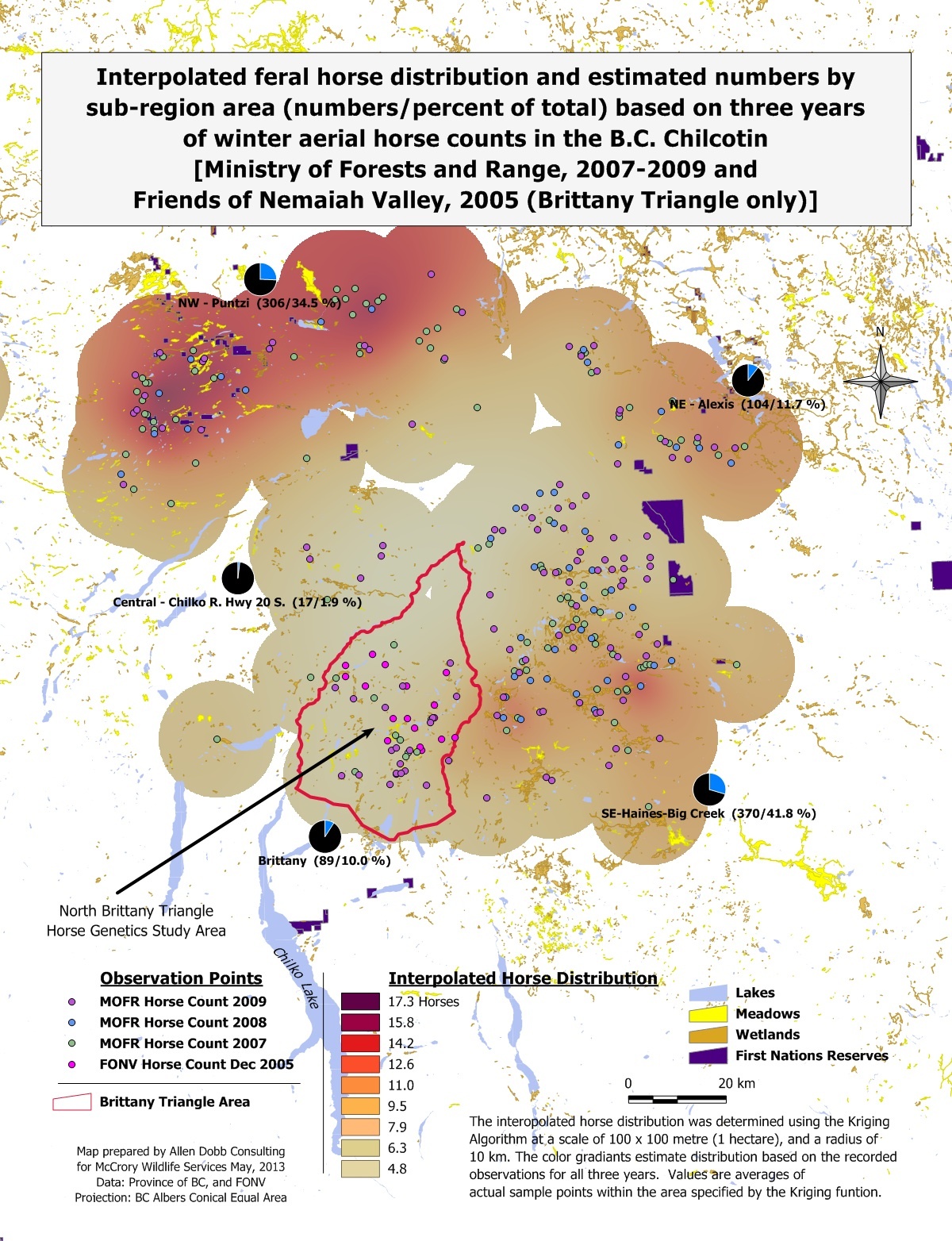
Although the 140 to 200 horses estimated by McCrory to be in the Brittany appear to have been there for a long time, testing is recommended to determine if some still retain the original gene for the Colonial Spanish Horse, as has been found in at least four wild herds in the U.S. Interviews with the local Xeni Gwet’in First Nations elders may also shed some light on historic presence of the Brittany wild horses.

Even if these original genetic linkages have been lost through successive dilutions with more recent Euro-breeds of horses, McCrory still considers the wild horses of the Brittany to be unique from a conservation and historic-cultural perspective.

Protection: as a symbol, or as a wild animal?

In the Brittany Triangle, there exists an opportunity to protect many things that have been all but lost in the modern world.

Very few wild horses survive in Canada today. In a 2002 documentary produced by Summerhill Entertainment, The Last Wild Mustangs, director Ian McRae sought out the remaining wild horses in Canada, and found only a few bands in the Alberta foothills besides those he filmed in the Brittany Triangle. He notes that outside of Sable Island in Nova Scotia, none of Canada’s wild horses is truly protected.

By comparison, in the United States, The Wild Free-Roaming Horses and Burros Congressional Act of 1971 now protects about 37,000 wild horses on BLM lands. The stated premise of that Act is to preserve “fast-disappearing symbols of the historic and pioneer spirit of the West.” So an element in American cultural tradition is being protected, without particular reference to its place in the natural environment. Although these horses are free-roaming, they exist mainly in what are euphemistically called CFZs, (carnivore free zones) where most large predators such as grizzly bears and wolves have already been extirpated. Since horse numbers are unchecked by natural predators, the BLM must “manage” them, resorting to methods of population control such as immunocontraceptive techniques and round-ups. Excess animals are rounded up and distributed in the Adopt-a-horse program which has placed over 140,000 captured wild horses with private parties. Although yearlings can be trained, many older adopted horses can never be tamed and eventually end their lives in the slaughter houses.

The BLM also tests the horses for equine infectious anemia (EIA). Those testing positive are killed. BLM horses might therefore be considered as controlled populations that are managed for their cultural significance. This is a different matter than protecting wild animals.

By contrast, the wild horses of the Brittany Triangle appear to have maintained stable populations, possibly for over two centuries in a natural ecosystem populated by their natural predators. At 4,500 feet, (1,400 m), the cold interior winters are extremely harsh, and the herds are naturally culled, weaker animals providing sustenance for wolves, cougars and bears.

Chief Roger William, caught on a remote camera as he rode through the trails. Photo: McCrory/FONV

The Xeni Gwet’in First Nations People have made their home in the Brittany Triangle for much longer than the 200 years the horses may have been there. Now a well established horse culture, the Xeni Gwet’in traditionally round up and capture the yearlings to maintain their stock of domestic horses. Although this contributes to population control, their relationship with the wild horses is mainly non-intrusive. Planned population control is absent except for their restraint from reducing herd sizes below sustainable numbers.

In their Aboriginal Wilderness Preserve Declaration, the Xeni Gwet’in First Nations government spurns industrial logging, mining, damming of waterways and excessive road-building within their territory. They clearly wish to preserve their claimed homeland in an ecologically holistic condition. FONV, through its protocol agreement with the Xeni Gwet’in, supports the Aboriginal Wilderness Preserve Declaration, and is now advocating that the Xeni Gwet’in should become the broadly recognized steward and authority for the protection of the wild horses within their claimed territory.

Informed decision making

When studies such as the FONV report are undertaken, it becomes evident that much more needs to be known about an area like the Brittany Triangle before large scale resource extractions can reasonably be contemplated. Extensive Forest Development Plans will cause catastrophic change to this delicate, high-altitude ecosystem. Especially vulnerable are the very thin soil layers found in the region. Although only a preliminary logging impact review has been done, Wayne McCrory observes in his report, Preliminary Conservation Assessment of The Rainshadow Wild Horse Ecosystem, Brittany Triangle, Chilcotin, British Columbia, Canada:

“A 40 km main haul road is planned to bisect most of the Brittany Plateau and this, combined with associated side-roads and extensive clearcuts of pine forests, would be the first thrust of a long period of mostly negative, cumulative impacts on the ecosystem. These cumulative impacts, which include high road densities, habitat alterations and escape-cover alterations and associated human disturbances such as increased hunting and poaching, have been well documented for sensitive “indicator” species such as grizzly bears and wolves. We suspect the reclusive feral horses would be negatively impacted as well . . .”

The extensive logging plans are difficult to justify with any criteria. The Brittany Triangle certainly does not promise economic riches. It is even doubtful if logging the Brittany can be a break-even proposition. The Ministry of Forests’ acceptable size for lodgepole pine logs is five inches in diameter at the butt end. One 40 cubic metre capacity logging truck can haul all the wood from an entire hectare. Stumpage rates are as low as 25 cents a cubic metre for “salvage” wood; at those rates, the province nets as little as $10 a hectare. Mills are an eight-hour return trip away. Government building of bridges and roads to access the sparse timber could certainly be challenged internationally as a subsidy to the industry. It appears the government objective is more likely to achieve Allowable Annual Cut (AAC) targets than to realize profits.

In the Brittany Triangle, there exists an opportunity to protect many things that have been all but lost in the modern world. In this place, there is an aboriginal population, long established and long sustained by the bounty of the land. There exists an untouched, fragile ecosystem, with an abundance of wildlife. In this place, horses exist in their wild state, in the conditions of their originating habitat. Until now this place has not felt the impact of any industrial activity – it is truly pristine – and the opportunity still exists to keep it this way.

Not surprisingly, after documenting high habitat values for grizzly bears, wolves, moose, wild horses, wild salmon and others, one of the final recommendations by the FONV report is

“that the Rainshadow Wild Horse Ecosystem (Brittany Triangle area) be recognized as wild horse refuge and be protected accordingly as western Canada’s first such sanctuary.”

GARTH WOODWORTH is the communications director for Friends of the Nemaiah Valley. He enjoys making videos of natural landscapes, especially around the acreage he shares with others in the beautiful Brittany Triangle.

This article first appeared in the Summer 2002 edition of Ecoforestry, the quarterly of the Ecoforestry Institute, based in Victoria, BC. www.ecoforestry.ca.